

Global Lighting Control System Market to Register a 13.0% CAGR by 2035
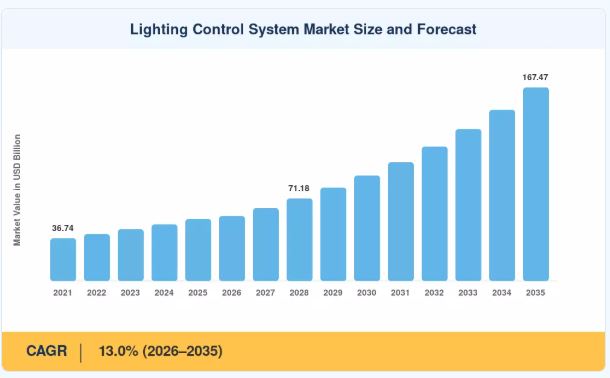
Lighting Control System Market
Lighting Control System Market Size, Share and Research Report By Component (Hardware, Software, Services), By Technology (Bluetooth, Wi-Fi, PLC)
Lighting Control System Market is gaining momentum as smart automation and energy efficiency become key priorities in residential, commercial, and industrial buildings.”
MADRID, MADRID, SPAIN, August 7, 2026 /EINPresswire.com/ -- The Global Lighting Control System market was valued at USD 53.32 billion in 2025 and is projected to reach USD 55.75 billion in 2026 before climbing to USD 167.47 billion by 2035, registering a CAGR of 13.0% during the 2026–2035 forecast period. This trajectory is anchored in tightening building energy codes California's Title 24-2025 now mandates automatic shut-off and daylight harvesting for interior spaces above 2,500 square feet and a global wave of commercial retrofit spending that the IEA estimates will exceed USD 80 billion annually by 2028. The market's 13.0% CAGR reflects the convergence of smart-city and connected-building programs (~2.4% impact), building energy-efficiency codes (~2.1%), retrofit mandate expansion (~1.9%), and LED driver and sensor cost deflation (~1.8%) accelerating across the world's most regulation-driven construction and urban-infrastructure markets simultaneously.— Market Research Future (MRFR)
A technology shift is reshaping the sector. Legacy toggle-switch and timer-based systems are giving way to sensor-driven, network-connected platforms that treat luminaires as data endpoints rather than fixed overhead. LED driver costs fell roughly 18% between 2022 and 2024, accelerating this transition and making cloud-commissioned, multi-protocol ecosystems economically viable even for mid-size facilities.
Hardware still accounts for the majority of market revenue, yet commissioning and analytics services are growing faster as multi-vendor deployments increase integration complexity. Asia-Pacific leads the market with a 38.4% revenue share in 2025, propelled by aggressive smart-city programs across China and India. The Middle East & Africa region is the fastest-growing at a projected 13.9% CAGR through 2035, fueled by Saudi Arabia's Vision 2030 infrastructure pipeline. North America holds the second-largest share at 27.5%, supported by stringent commercial building codes and strong retrofit activity. The decade ahead will be defined by convergence, where lighting, HVAC, and security share a single data backbone.
Get Full PDF Sample Copy of Report: (Including Full TOC, List of Tables & Figures, Chart) @
https://www.marketresearchfuture.com/sample_request/3822
➤ How Significant Is the Lighting Control System Market's Growth?
The lighting control system market's trajectory from USD 53.32 billion in 2025 to a projected USD 167.47 billion by 2035 represents more than a three-fold expansion over the forecast decade, reflecting the structural shift from discretionary lighting upgrades toward compliance-mandated, sensor-driven building infrastructure. The market's 13.0% CAGR is anchored in a regulatory-and-technology convergence cycle where tightening energy codes, smart-city IoT procurement, and falling LED driver costs are all converging to make networked lighting control a default specification rather than an optional add-on.
Hardware dominated the market in 2025 with a 55.5% revenue share, driven by ongoing sensor and driver replacements across commercial buildings, while services are the fastest-growing offering segment at a 14.2% CAGR as multi-protocol ecosystems demand specialized commissioning and managed-service contracts. Wired communication protocols, including DALI and KNX, held a 64.8% share of the market in 2025, though wireless alternatives are expanding at a 13.7% CAGR as retrofit projects increasingly favor cable-free sensor networks. Retrofit installations are capturing a 14.0% CAGR through 2035, outpacing new construction as policy mandates force existing buildings to upgrade, and indoor deployments accounted for 68.0% of market sales in 2025, led by commercial office and retail environments.
➤ What Does the Future Hold for the Lighting Control System Market?
Smart-city and connected-building programs contribute approximately 2.4 percentage points to the lighting control system market's CAGR the single highest driver impact. China's New Infrastructure initiative allocated CNY 140 billion toward urban IoT networks between 2023 and 2025, with street-lighting platforms serving as anchor nodes for environmental sensors and traffic management, while India's SLNP program has already converted over 20 million streetlights to LED and is now layering centralized monitoring and dimming capabilities onto the installed base. These programs generate multi-billion-dollar procurement cycles that strengthen the market across Asia-Pacific.
Building energy-efficiency codes contribute approximately 2.1 percentage points to the CAGR, establishing regulatory compliance as a primary near-term demand source. The 2024 International Energy Conservation Code now requires automatic shut-off, daylight-responsive dimming, and demand-response capability in commercial spaces exceeding 5,000 square feet, while California's Title 24-2025 mandates continuous dimming and occupancy sensing in all newly permitted non-residential projects.
These codes convert the market from a discretionary upgrade into a compliance necessity across the roughly 5.9 million U.S. commercial buildings the DOE identifies as pre-2010 stock lacking modern controls. Retrofit mandate expansion adds a further 1.9% to the CAGR as the EU Energy Efficiency Directive recast requires member states to renovate 3% of public building floor area annually starting in 2025, with the European Commission estimating a 35–50% energy reduction from installing daylight and occupancy controls in pre-2000 office buildings.
The next product generation is shifting toward AI-driven autonomous lighting, with luminaire-level dimming expected to be managed by machine-learning algorithms operating at the edge without human scheduling inputs by 2030. Predictive occupancy models trained on months of sensor data will modify output prior to occupant arrival, and autonomous controls are projected to reduce commercial lighting energy consumption by an additional 15–25% beyond static scheduling. Lighting control platforms are also evolving into building-intelligence operating systems that absorb HVAC, access control, and air-quality monitoring, with vendors who control the middleware layer translating between DALI-2, BACnet, and wireless mesh positioned to capture disproportionate value as subscription-based software pricing overtakes one-time licensing by 2032.
Get access to the full description of the report @
https://www.marketresearchfuture.com/reports/lighting-control-system-market-3822
➤ Who Are the Key Players in the Lighting Control System Market?
The lighting control system market exhibits low concentration, with an estimated top-five share of 32–38% and a Herfindahl-Hirschman Index below 600. The competitive field spans diversified electrical conglomerates, pure-play lighting specialists, and building-automation platform vendors, with strategic M&A activity intensifying as players seek to assemble full-stack offerings combining hardware, software, and cloud services under a single brand. MRFR identifies the following key participants with estimated revenue share ranges:
Signify N.V. (~7–10% share) - the full-stack IoT lighting leader providing the Interact platform and Philips Dynalite, having launched Interact City 2.0, a cloud platform enabling municipalities to manage up to 500,000 connected streetlights with AI-based fault detection.
Lutron Electronics (~6–9% share) - a premium commercial and residential controls specialist providing Vive wireless and HomeWorks QSX systems, with deep channel penetration among architects and lighting designers specifying high-end installations.
Acuity Brands (~5–8% share) - a software-centric building intelligence provider offering the Atrius IoT platform and nLight controls, having acquired a cloud-analytics startup to integrate real-time occupancy intelligence into its building-management suite.
Legrand S.A. (~4–6% share) - a retrofit-focused modular systems provider offering Wattstopper and its Eliot IoT program, with particular strength in cost-effective retrofit-oriented sensor and control panel deployments.
Eaton Corporation (~3–5% share) - a grid-interactive commercial platform provider offering Greengate and WaveLinx systems, positioning lighting control as a demand-response-ready asset for utility load-shedding programs.
Schneider Electric (~3–5% share) - an integrated building-management-system provider offering EcoStruxure Building with embedded lighting modules, having integrated its platform with Microsoft Azure Digital Twins for real-time facility simulation.
Hubbell Incorporated (~2–4% share) - an industrial and commercial wiring systems specialist providing NX Lighting Controls and Wiremold, with established distribution across electrical-contractor channels.
Honeywell International (~2–4% share) - an enterprise-scale integration player providing its Building Management Platform with embedded lighting control modules, leveraging its broader facility-automation portfolio.
Crestron Electronics (~2–3% share) - a premium AV-integrated lighting specialist offering Crestron Lighting and DM NVX systems, serving high-end residential and corporate boardroom installations.
Zumtobel Group (~1–3% share) - a European specification-grade specialist providing Litecom and DALI-2 systems, with strong positioning among architects specifying premium European lighting-control installations.
Strategic competition in the lighting control system market is increasingly defined by middleware translation capability across coexisting protocols with protocol fragmentation cited as the top adoption barrier, as a 2024 ASHRAE survey found that 41% of facility managers cited multi-vendor integration as the primary obstacle to upgrading controls alongside high upfront capital costs for small commercial projects, cybersecurity vulnerabilities in networked systems, and a shortage of trained commissioning professionals.
➤ What Are the Emerging Trends in the Lighting Control System Market?
Several transformational trends are redefining the lighting control system market's evolution through 2035:
Building Energy-Efficiency Codes: Tightening standards such as the 2024 International Energy Conservation Code and California's Title 24-2025 are mandating automatic shut-off, daylight-responsive dimming, and demand-response capability, converting lighting controls from a discretionary upgrade into a compliance necessity across millions of pre-2010 commercial buildings.
Smart-City and Connected-Building Programs: China's New Infrastructure initiative and India's SLNP program are layering centralized monitoring and dimming capabilities onto national streetlight networks, using lighting platforms as anchor nodes for broader urban IoT sensor deployment.
Retrofit Mandate Expansion: The EU Energy Efficiency Directive recast requires member states to renovate 3% of public building floor area annually starting in 2025, with lighting controls representing one of the lowest-cost, highest-impact retrofit measures delivering a 35–50% energy reduction in pre-2000 office buildings.
As-a-Service Business Models: Lighting-as-a-Service bundles hardware, commissioning, and analytics into monthly operating expenses, eliminating upfront capital barriers, with LaaS contracts projected to grow at roughly 18% annually through 2030 as financing structures mature.
Data Monetization Through Occupancy Analytics: Continuous occupancy and illumination data generated by lighting sensor networks are enabling applications beyond energy management, including HVAC co-optimization, space-utilization analytics, and retail foot-traffic mapping, unlocking recurring software revenue streams for platform-positioned vendors.
Buy Full Research Report:
https://www.marketresearchfuture.com/checkout?currency=one_user-USD&report_id=3822
➤ How Is the Lighting Control System Market Segmented?
The lighting control system market report provides a comprehensive segmentation framework:
By Offering: Hardware (55.5% share, 2025), Software (13.4% CAGR), Services (14.2% CAGR)
By Communication Protocol: Wired (DALI, KNX; 64.8% share, 2025), Wireless (13.7% CAGR)
By Installation Type: New Construction (39.5% share, 2025), Retrofit (14.0% CAGR)
By Application: Indoor (68.0% share, 2025), Outdoor (14.1% CAGR)
By Region: Asia-Pacific (38.4%), North America (27.5%), Europe (22.1%), South America (5.2%), Middle East & Africa (13.9% CAGR)
➤ What Are the Regional Insights from the Lighting Control System Market?
Asia-Pacific leads the lighting control system market with a 38.4% revenue share in 2025, with China commanding 41.2% of regional revenue through its New Infrastructure IoT initiative. India is posting a 15.1% CAGR within the region through its SLNP streetlight modernization program and ECBC compliance requirements, Japan holds 18.4% of regional share through mandatory zero-energy-building targets for new public buildings by 2030, South Korea contributes 11.3% through its Green New Deal building standards, and ASEAN is growing at a 14.6% CAGR through urbanization and commercial construction activity.
North America holds approximately 27.5% of global lighting control system market share, with the United States commanding 78.3% of regional revenue through Title 24 and IECC 2024 compliance requirements, supported by federal tax incentives under IRA Section 179D that continue to subsidize qualified lighting control upgrades in commercial and tax-exempt properties. Canada contributes 13.1% of regional revenue through National Building Code updates, and Mexico is growing at a 14.2% CAGR through urban commercial construction growth.
Europe accounts for approximately 22.1% of global lighting control system market share, with Germany commanding 24.6% of regional revenue through Energiewende building codes and the UK contributing 19.8% through Part L Building Regulations. France is growing at a 13.5% CAGR through its décret tertiaire, requiring all tertiary buildings above 1,000 square meters to cut energy consumption 40% by 2030 relative to a 2010 baseline, Italy holds 12.4% of regional share through Superbonus renovation incentives, Spain is posting a 13.3% CAGR through CTE building code modernization, and the Nordic countries contribute 10.2% through early smart-building adoption.
The Middle East & Africa is the fastest-growing region in the lighting control system market, posting a forecast CAGR of 13.9% through 2035, with Saudi Arabia commanding 33.7% of regional revenue through Vision 2030 and giga-projects including NEOM, The Line, and Jeddah Tower that specify fully autonomous building-management systems integrating lighting, HVAC, and security on a unified platform. The UAE holds 27.4% of regional share through its Estidama and Al Sa'fat green-building rating systems mandating smart lighting controls for all new commercial permits in Dubai, South Africa is growing at a 13.4% CAGR through SANS 10400-XA compliance, and Egypt is posting a 14.1% CAGR through New Administrative Capital infrastructure. South America holds roughly 5.2% of global revenue, with Brazil commanding 62.5% of regional share through PROCEL efficiency labels and municipal LED streetlight public-private partnership contracts, and Argentina posting a 12.8% CAGR through urban infrastructure investment.
➤➤➤ Regional & Country-Level Reports by Market Research Future:
US Lighting Control System Market -
https://www.marketresearchfuture.com/reports/us-lighting-control-system-market-14139
➤➤➤ Industry Analysis Reports by Market Research Future:
Private Banking Market
https://www.marketresearchfuture.com/reports/private-banking-market-23978
Property Casualty Insurance Market
https://www.marketresearchfuture.com/reports/property-casualty-insurance-market-33407
Quadruped Robot Market
https://www.marketresearchfuture.com/reports/quadruped-robot-market-36232
Real Time Operating System Market
https://www.marketresearchfuture.com/reports/real-time-operating-system-market-34731
Rf Plasma Generator Market
https://www.marketresearchfuture.com/reports/rf-plasma-generator-market-36646
Risc V Tech Market
https://www.marketresearchfuture.com/reports/risc-v-tech-market-38126
Robotic Window Cleaners Market
https://www.marketresearchfuture.com/reports/robotic-window-cleaners-market-24361
Safety Laser Scanner Market
https://www.marketresearchfuture.com/reports/safety-laser-scanner-market-42898
Security Surveillance Storage Market
https://www.marketresearchfuture.com/reports/security-surveillance-storage-market-37690
Sagar Kadam
Market Research Future
+ +1 628-258-0071
email us here
Legal Disclaimer:
EIN Presswire provides this news content "as is" without warranty of any kind. We do not accept any responsibility or liability for the accuracy, content, images, videos, licenses, completeness, legality, or reliability of the information contained in this article. If you have any complaints or copyright issues related to this article, kindly contact the author above.
